What is a MES?
The problem: flying blind
Imagine running a factory where:
- An operator writes downtime events on paper or in Excel. By the time a manager sees the report, it is already next week.
- A machine has been running 20% slower than expected for three days, but nobody noticed because there is no real-time monitoring.
- Two shifts produce the same product on the same line, but one shift consistently produces 30% more, and nobody knows why.
- A quality issue caused 500 defective parts before anyone caught it, because the inspection data was not connected to the production data.
This is what manufacturing looks like without a MES. Decisions are based on gut feelings, reports arrive too late, and problems are discovered after the damage is done.
The solution: a MES
A MES (Manufacturing Execution System) is software that sits on the factory floor and connects machines, operators, and managers in real time.
Think of it like this:
| Without MES | With MES |
|---|---|
| Paper logs and Excel | Real-time digital dashboards |
| "I think we had about 2 hours of downtime" | "We had 1h 47min of downtime across 12 events" |
| Problems found days later | Problems visible in seconds |
| No data to compare shifts or lines | Side-by-side performance comparison |
| Tribal knowledge ("ask Jean, he knows") | Structured data everyone can access |
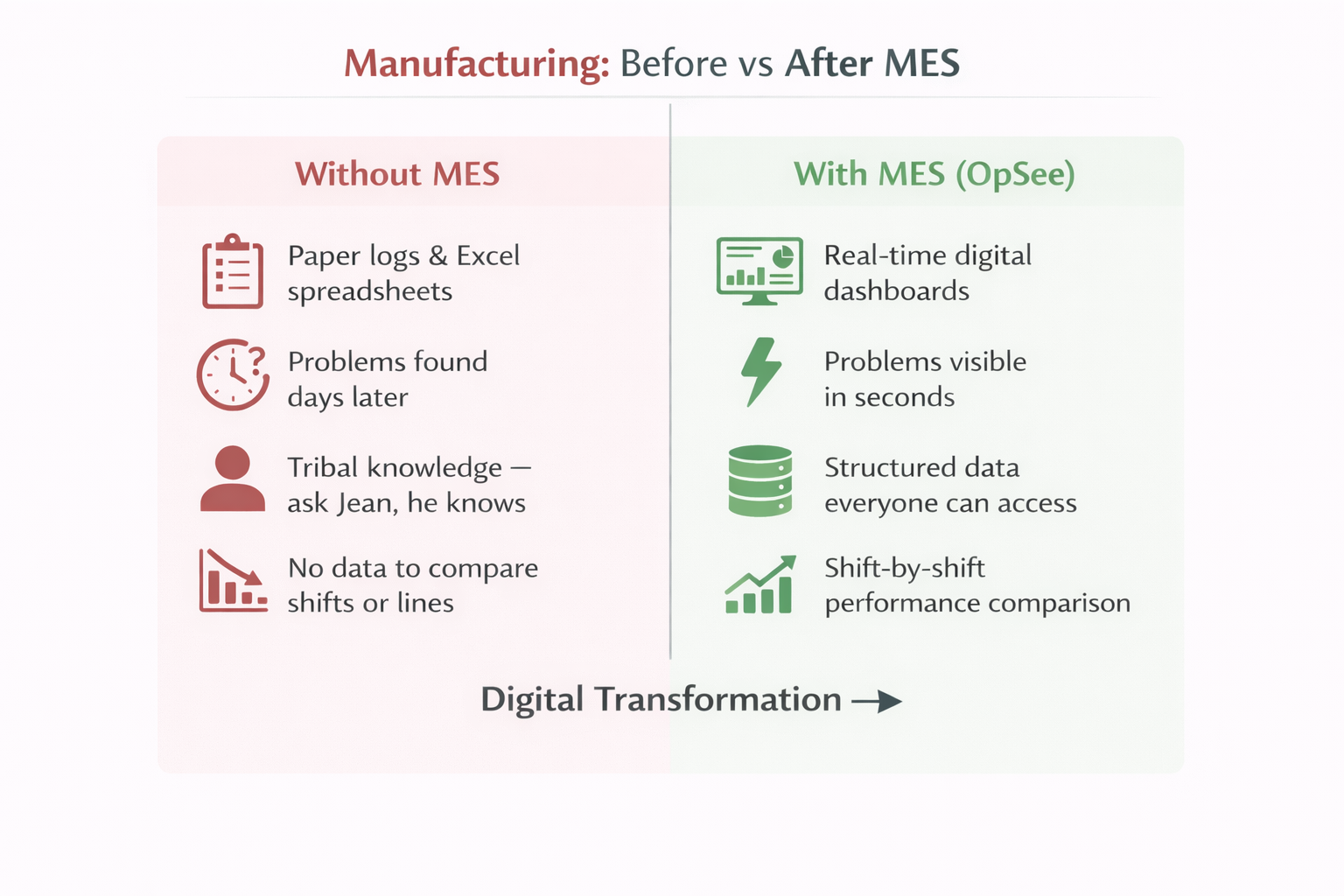 The transformation a MES brings to manufacturing operations.
:::info In one sentence A MES digitizes the factory floor. It captures what happens on every machine, in real time, and turns it into actionable data for everyone from the operator to the plant director. :::
What does a MES do?
A MES is a broad operational backbone. It is much more than OEE tracking. The international reference is the MESA-11 functional model (MESA International, 1997), refined by the ISA-95 standard (Part 3, manufacturing operations management). Together they describe eleven core functional areas that every complete MES is expected to cover, plus modern extensions for batch industries, scheduling, and digital work instructions.
The eleven functional areas (MESA-11)
| # | Functional area | What it does | Concrete example |
|---|---|---|---|
| 1 | Resource allocation & status | Tracks the availability and state of equipment, tools, materials, and personnel | "Filler #3 is running, Filler #4 is in changeover, the QC inspector is on Line 2" |
| 2 | Operations scheduling | Sequences and prioritizes production at the machine level (detailed scheduling, finite capacity) | "Run Order A on Line 1 from 06:00 to 11:30, then changeover 30 min, then Order B until 18:00" |
| 3 | Dispatching production units | Sends work orders, jobs, and instructions to operators and equipment in real time | "Operator on Line 1, your next job is Order #4729: produce 5000 units of Product X" |
| 4 | Document control | Manages SOPs, work instructions, drawings, certifications, and quality documents at the operator station | "Step 4 of the procedure: tighten to 25 Nm. Tap the picture to enlarge." |
| 5 | Data collection & acquisition | Pulls data from PLCs, sensors, and operators in real time and stores it in a single place | "Every second: temperature, pressure, speed, counter from each machine" |
| 6 | Labor management | Tracks operators, shifts, skills, training, and time-on-task | "Team A is assigned to Line 1, morning shift. Marie is qualified for Line 1 and Line 2." |
| 7 | Quality management | Records inspections, defects, non-conformances, and statistical process control (SPC) | "Batch 2847 had 12 rejects at station 4. Root cause: out-of-tolerance temperature." |
| 8 | Process management | Monitors execution, alarms, deviations, and enforces process limits | "Line 2 stopped: pressure exceeded 5.2 bar. Auto-paused, alarm sent to supervisor." |
| 9 | Maintenance management | Schedules preventive maintenance, tracks repairs, and links failures to equipment history | "Filler head #3 maintenance due in 50 operating hours. Last failure: bearing replaced 4 months ago." |
| 10 | Product tracking & genealogy | Traces every unit or batch from raw material to delivery (full forward and backward traceability) | "Bottle #847291 was filled from Tank 3, lot R-245, on Line 1, by Marie, at 14:32." |
| 11 | Performance analysis | Computes OEE, KPIs, trends, dashboards, and reports for managers and continuous improvement | "Line 2 OEE this week: 71.4%. Top loss: unplanned downtime, 18% of planned time." |
Batch and recipe management (ISA-88)
For batch industries (food, beverage, pharmaceuticals, chemicals, cosmetics), a MES also covers a dedicated set of capabilities defined by the ISA-88 standard:
- Recipe management: master recipes, site recipes, and control recipes that bind a recipe to a specific equipment train
- Formulas & parameters: ingredients, ratios, setpoints (temperature, pressure, mixing time), variants per equipment
- Batch execution: starting, pausing, completing batches; recording phase-by-phase actuals; managing splits, merges, and re-runs
- Equipment requirements: ensuring a recipe runs only on equipment that meets its constraints (capacity, contact materials, cleaning state)
- Changeover rules: what must be cleaned or reconfigured between two consecutive batches (allergen-to-allergen, color-to-color, product-to-product)
Modern extensions
Beyond MESA-11 and ISA-88, modern MES platforms typically extend to:
- Advanced scheduling (APS): finite-capacity planning, what-if scenarios, drag-and-drop Gantt boards
- Digital work instructions: step-by-step SOPs at the operator screen, with pictures, videos, and electronic sign-off
- Energy & sustainability: track energy per unit, water consumption, compressed air, scrap rate
- WIP (work-in-progress): where every unit is right now in the plant, in real time
- ERP integration: receive production orders from the ERP, push back actuals (good units, scrap, downtime, OEE)
:::tip Why is OEE often the first focus? In practice, OEE is often the first MES capability companies deploy. There are good reasons: OEE is the most universal manufacturing KPI, it produces visible results within weeks, and it requires the simplest data, namely machine state, speed, and quality counts.
But OEE is the gateway, not the destination. A complete MES covers the eleven functional areas above plus batch execution, scheduling, work instructions, traceability, and ERP integration. Once OEE is in place and the data foundation is built, the other capabilities follow as the operational backbone matures.
If you only remember one thing from this page: a MES is a broad system, and OEE is just one of its many functions. :::
Where does a MES fit?
A MES sits between the factory floor (machines, sensors, PLCs) and the business systems (ERP, finance, planning):
- ERP tells the MES "we need 5000 units of Product X by Friday"
- The MES tells the factory floor "run Recipe X on Line 1 with these parameters"
- The factory floor tells the MES "machine stopped at 14:32, temperature is 85.2C, 3247 units produced"
- The MES tells the ERP "order completed, 4985 good units, OEE was 78.3%"
:::tip The bridge A MES is the bridge between the physical world (machines) and the digital world (business systems). Without it, there is a blind spot between "what we planned" and "what actually happened." :::
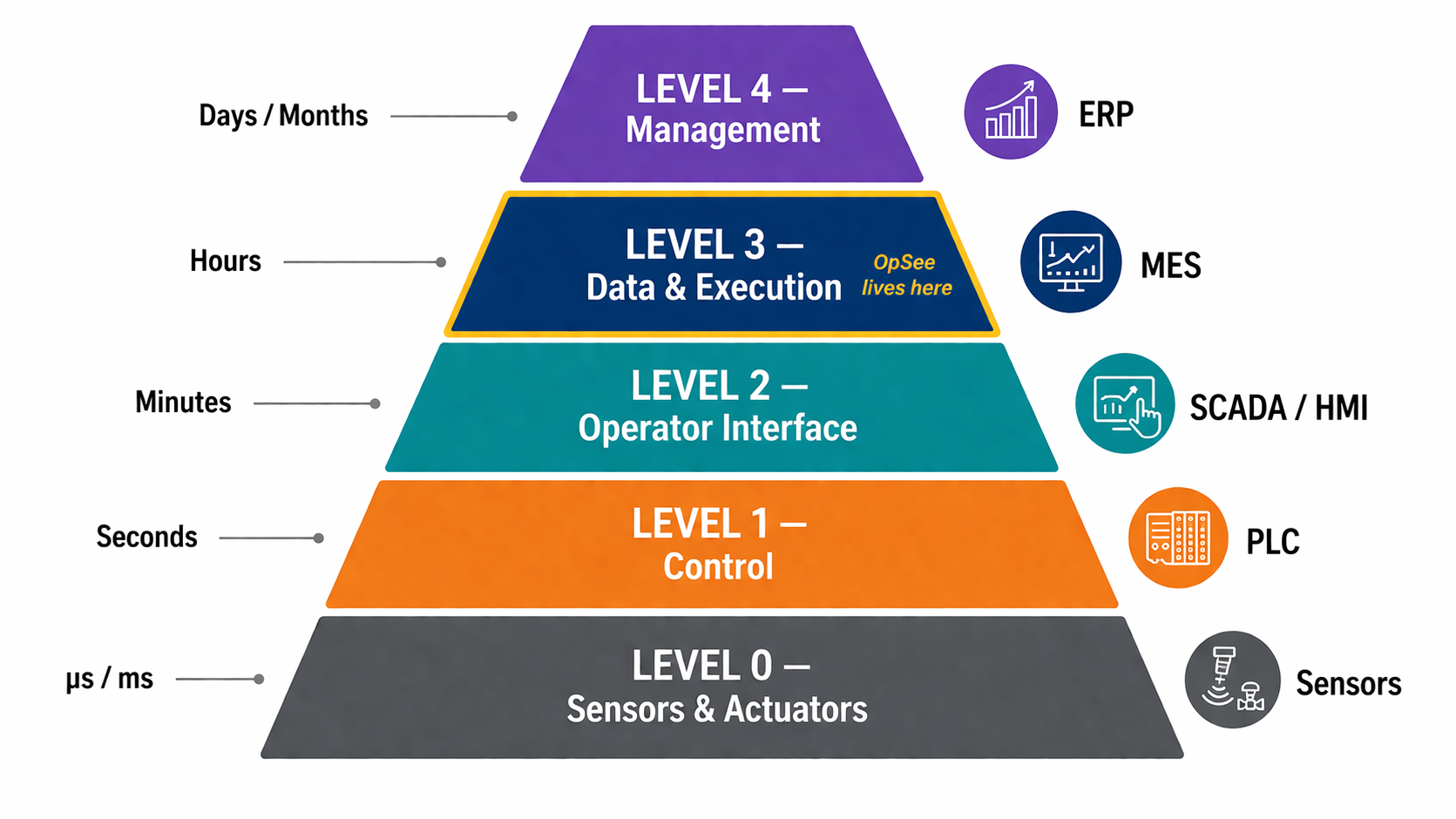
A typical day with a MES
Here is what a typical day looks like in a factory equipped with a MES. Notice how multiple MES capabilities, not just OEE, work together every minute of every shift.
06:00: morning shift starts. The MES dashboard shows yesterday's plant OEE: 71.4%. The biggest loss was unplanned downtime on Line 2. (performance analysis)
07:15: Line 2 stops. The data collection layer detects the stop in seconds and creates a downtime event in the timeline. The operator opens the MES on a shop-floor tablet, sees the event, and selects a reason: "Material shortage, waiting for resin delivery."
09:30: the supervisor opens the performance analysis dashboard, sees Line 2 has been down for 2h15. She uses the MES to reassign the operator to Line 1 in the meantime, and calls logistics to expedite the delivery. (resource allocation)
11:00: resin arrives. The MES dispatches the next production order to Line 2. The operator follows the work instructions displayed on the tablet to set up the line. Process management monitors the restart and alarms if any setpoint drifts.
14:00: the plant manager reviews the performance analysis dashboards. He sees this week's OEE trend, the top 5 downtime reasons, and that Line 2's material shortage issue is recurring. He schedules a meeting with logistics to fix the root cause.
21:30: end of shift. Product tracking & genealogy records that 4985 good units were produced on Line 2, traced back to raw material lot R-245, by the morning team. The MES sends actuals back to the ERP, which updates inventory and order fulfillment.
This entire flow happens in real time, on a single platform, with zero paper. It illustrates how a MES orchestrates many capabilities, from data collection to genealogy and back to the business systems.
Next steps
Now that you understand what a MES is, dive into the core concepts:
- OEE Fundamentals: the #1 metric in manufacturing and a typical entry point into MES
- Equipment Model (ISA-95): how to describe your factory structure
- Batch Model (ISA-88): how to describe your manufacturing processes and recipes
- Data Flow: how data moves from sensors to dashboards
- Glossary: definitions of all key terms
Prerequisites
- Introduction: the overall picture of OpSee
Related
- OEE Fundamentals: the metric most often deployed first in a MES journey
- Equipment Model (ISA-95): the ISA-95 equipment hierarchy in detail
- Batch Model (ISA-88): the ISA-88 batch and recipe model
- Data Flow: how data moves from sensors to the MES
- Glossary: definitions for MES, MESA-11, SCADA, PLC, ERP, ISA-95, ISA-88, and more